AI for Science
PocketStop
Risk-aware decisions from early molecular-dynamics data.
Can early simulation data identify runs that are not worth continuing without discarding too many runs that would later meet the study's endpoint?
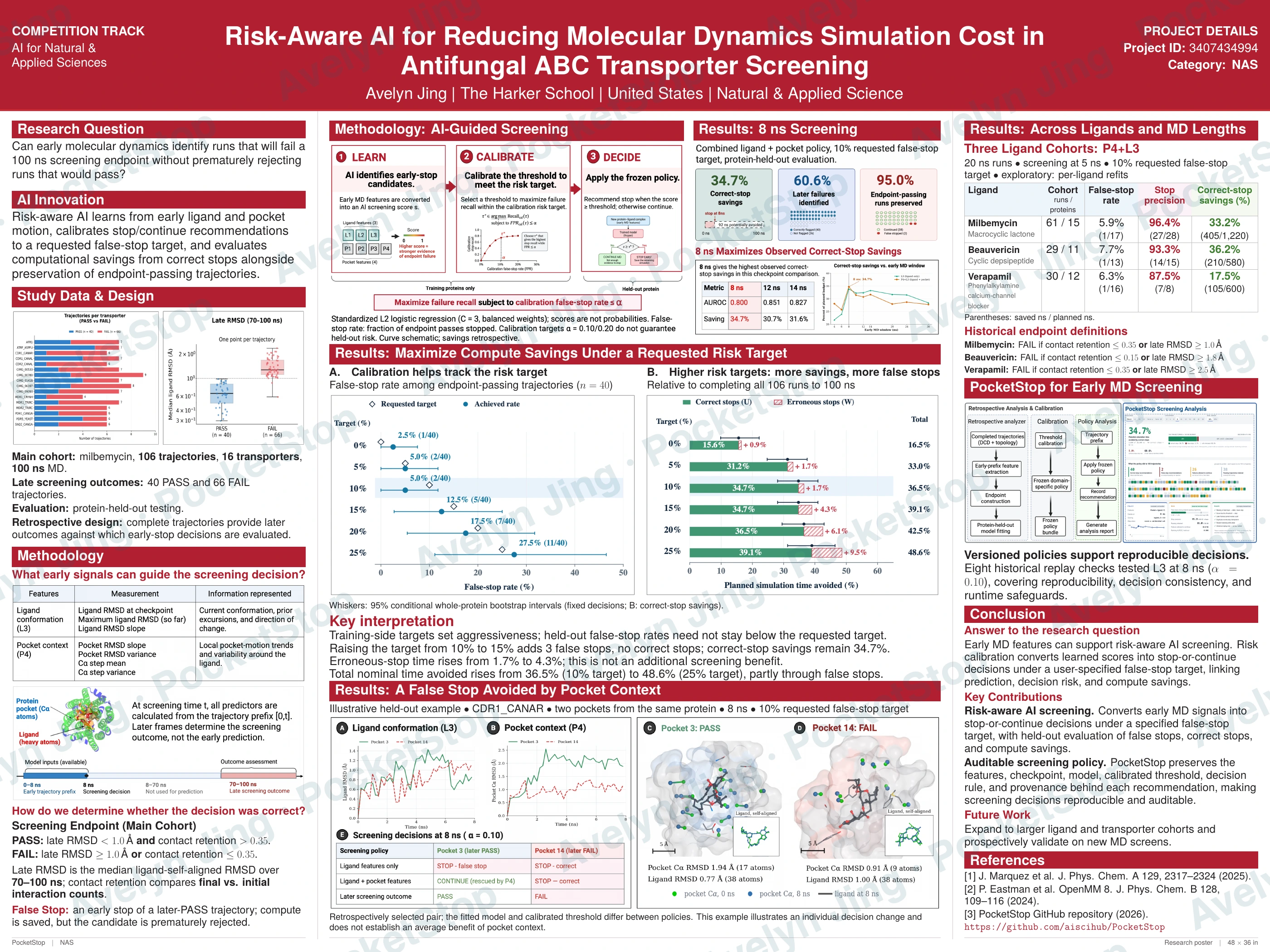
PocketStop uses early ligand- and pocket-motion features to make risk-calibrated stop-or-continue recommendations for molecular-dynamics screening.
The primary retrospective study evaluates 106 completed 100 ns milbemycin trajectories using protein-held-out testing, with held-out proteins excluded from both model fitting and threshold calibration.
Key Results
Held-out milbemycin evaluation · 106 historical 100 ns runs · screening at 8 ns · 10% false-stop target
- Endpoint-passing runs preserved
- 95.0%
- Proportion of runs that would have met the endpoint and were not stopped (38 of 40)
- Later failures identified
- 60.6%
- Proportion of runs that did not meet the endpoint and were correctly stopped (40 of 66)
- Simulation time saved
- 34.7%
- Planned simulation time avoided through correct stops, relative to completing all 106 runs to 100 ns
How It Works
The user sets the false-stop target; calibration determines the stopping threshold.
Early trajectory
Only the first 8–12 ns of a planned 100 ns simulation is used.
Ligand + pocket motion
Seven features describe how the ligand changes shape and how the pocket around it moves.
Predictive model
Logistic regression combines the features into one stop score; a higher score favors stopping.
Risk calibration
The cutoff is set to catch the most failures while keeping false stops within the target.
Decision
A frozen policy applies the cutoff to proteins it has never seen.
Check at 8 ns, then decide. Two simulations of the same held-out protein, at the 8 ns checkpoint with a 10% false-stop target.
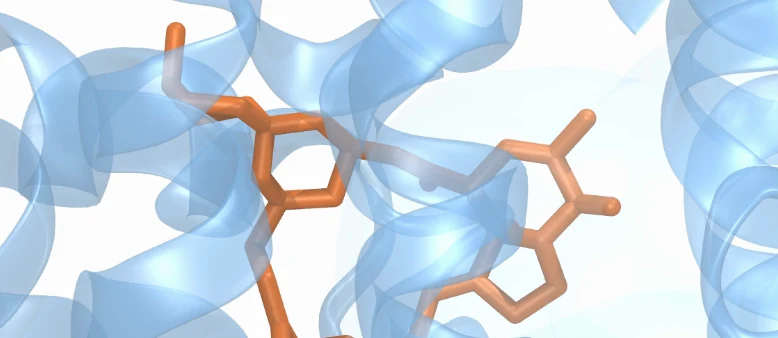
Decision at 8 ns: ContinueResult at 100 ns: Pass

Decision at 8 ns: StopResult at 100 ns: Fail
Small molecule (milbemycin)Protein pocketReal molecular-dynamics snapshots. Retrospective replay of two completed simulations, selected as an example; the model saw only the first 8 ns.
Each recommendation records the checkpoint, features, fitted model, threshold, decision rule, and provenance needed to reproduce the decision.
What I Did
I defined the research problem, ran the simulations and machine-learning analyses, analyzed the data, wrote the paper as its sole author, and released PocketStop as open-source software.
- Designed the evaluation framework
- Ran MD simulations
- Implemented machine-learning models
- Calibrated risk-based decision thresholds
- Built the analysis pipeline and documentation
- Wrote the paper and created the open-source release