Applied Computing
CookieGuard AI
Cookie security checks for AI browser agents, automated tests, and CI.
Can a successful login still leave its session cookie insecure?
CookieGuard AI helps build trust in AI browser agents by independently checking how their login cookies are protected.
1,852 reported downloads across 6 npm and PyPI packages (through Nov 5, 2026; 1 package awaiting its first report; includes recorded snapshot). The Browser Use integration is also available as a Python beta, and an MCP server is available as a development preview. Download counts include dependencies and repeat installs, so they do not represent unique users.
The Original Extension in Use
Screenshots from the Chrome extension, which remains part of the expanded project.
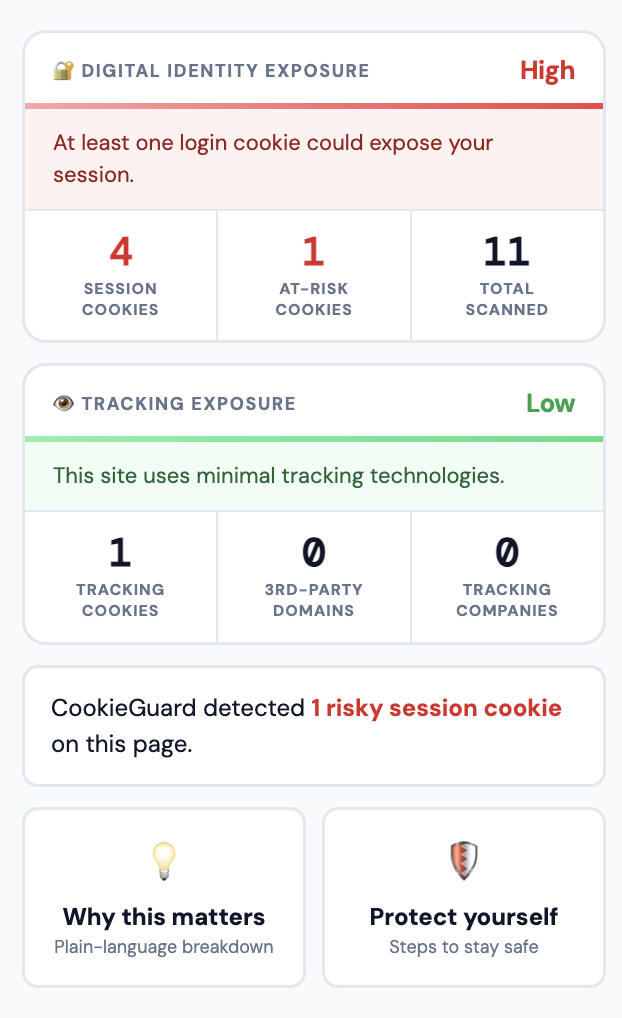
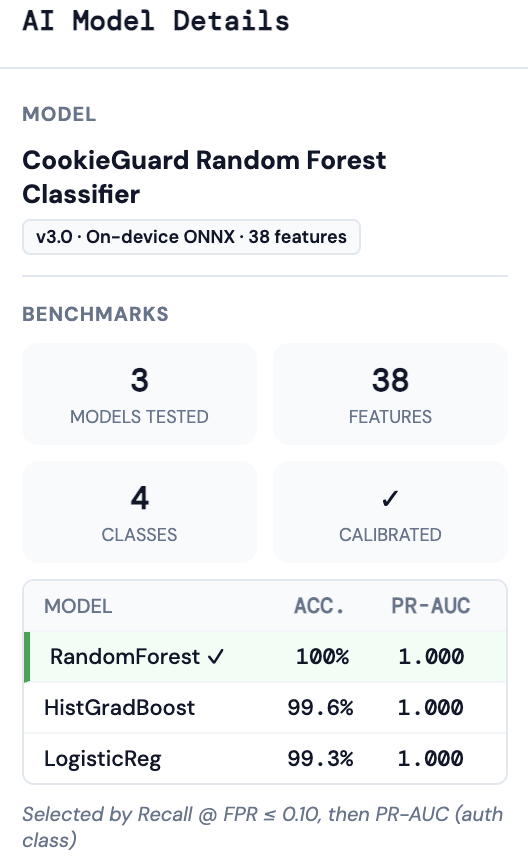
A flag indicates a potential risk in how a cookie is configured, not proof of an exploit. The benchmark scores come from synthetic cookie data and describe controlled conditions, not real-world accuracy.
From Browser Extension to Developer Toolkit
Local cookie-policy checks across browser agents, tests, and CI. The MCP integration is a development preview.
Browser Use agents
A Python beta observes cookies during an AI agent's browser workflow. The local engine evaluates the evidence, and the calling code can enforce the result even when the agent reports success.
Playwright tests
The npm adapter collects cookie declarations and browser observations during login tests, so a successful login can still fail the configured cookie policy.
CLI and GitHub Action
Check response headers from a test application, produce reports without cookie values, and return distinct outcomes for a pass, a confirmed violation, or an incomplete audit.
MCP server preview
Two local tools let an AI client inspect the configured policy and scan an allowed endpoint. This development preview runs from the repository; it is not yet an npm release.
Evidence and explanations
Checks cover HttpOnly, Secure, SameSite, domain scope, lifetime, cookie prefixes, and regressions. Findings include the evidence and suggested fix; uncertain cases remain review items.
Original Chrome extension
The extension still offers interactive scans, an on-device authentication-cookie classifier, tracking-cookie identification, and plain-language explanations.
The Browser Use and Playwright integrations observe authenticated browser workflows. The CLI, Action, and MCP preview inspect response headers without logging in. The local policy engine reports pass, fail, or incomplete; a pass covers the configured cookie checks, not the security of the whole application.
What I Did
I designed and published the original Chrome extension, then expanded CookieGuard into a toolkit for developers and AI browser agents. The project keeps the reasoning visible through explicit policy checks, evidence, and suggested fixes, with examples that demonstrate both passing and failing configurations.
- Built the Chrome extension and on-device classifier
- Expanded the local cookie-policy engine and explanations
- Released three npm packages for the CLI, core engine, and Playwright
- Added a GitHub Action and reproducible pass/fail demos
- Released the Browser Use integration as a Python beta
- Added an MCP server preview for AI clients