Applied Computing
AirWater AI
Evidence-aware site screening for atmospheric water harvesting.
Is water-from-air worth testing at a given site, and if so, which material and operating schedule should be tested first?
AirWater AI screens whether harvesting water from air is worth testing at a specific site, and with which material and daily schedule.
Metal-organic frameworks (MOFs) can capture water vapor from air, but the material with the highest laboratory capacity is not always the one that produces the most usable water in a given climate. AirWater AI matches measured material behavior to a site's hourly climate and available heat.
Data & Validation
Leave-one-MOF-out test · each material is predicted from the other eleven
- Measured data points
- 1,226
- 28 experimental water isotherms for 12 MOFs, from 13 published papers
- Lower error than baseline
- 14%
- Held-out error of 0.119 vs 0.138 kg/kg (mean absolute error)
- Held-out R²
- 0.24
- Up from −0.10 for the baseline; transfer to an unseen material remains limited
Three further exploratory materials have no measured isotherm and are excluded from training. The model improved on a baseline, but transfer to an unseen material remains limited, so predictions are screening signals.
How It Works
The same inputs can end in a recommendation or a refusal.
Describe the site
Location, month, daily water target, material mass, and available heat.
Build the climate
An hourly profile of temperature, humidity, and solar availability from NASA POWER data.
Predict uptake
Measured isotherms give each material's water uptake; a model fills only small gaps.
Rank and schedule
Candidates are ranked by yield, climate fit, heat feasibility, and evidence, with a 24-hour capture and release plan.
Decide
Seven checks end in a recommendation, a caution, or a do-not-deploy verdict.
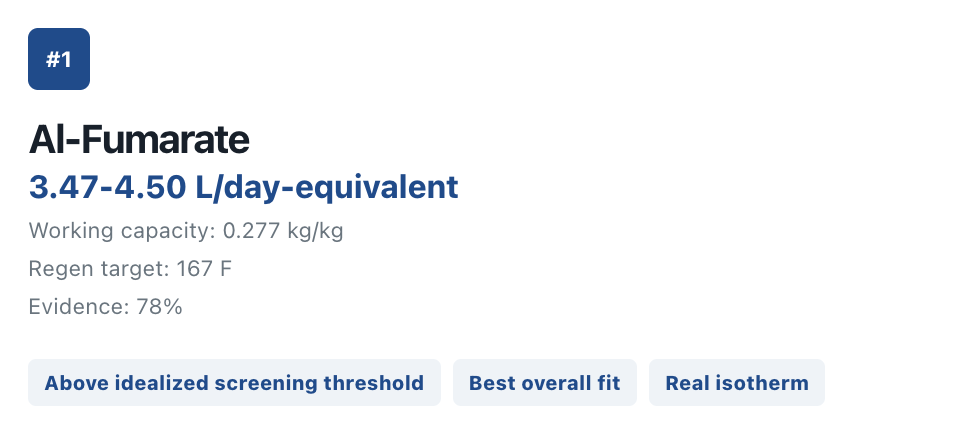
Same site, two seasons. Phoenix, Arizona, with a 3 L/day target, 8 kg of material, and solar heat up to 176 °F. Only the month changes.
JulyAbove idealized screening threshold
JanuaryDo not deploy
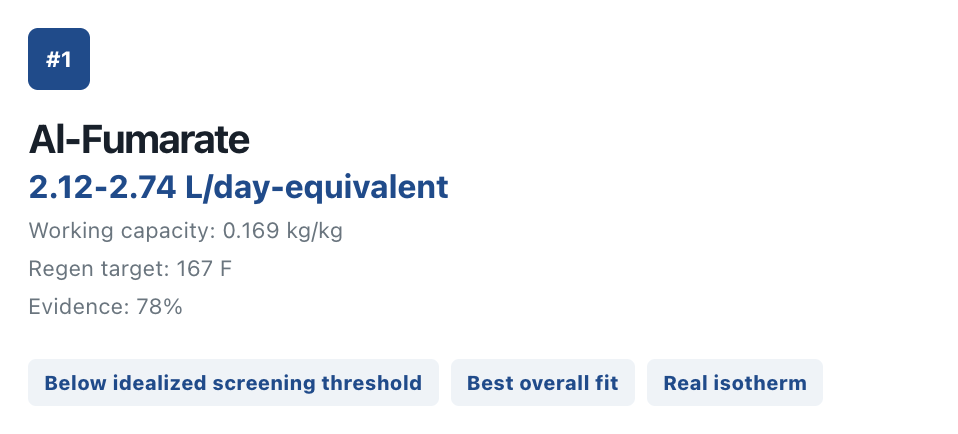
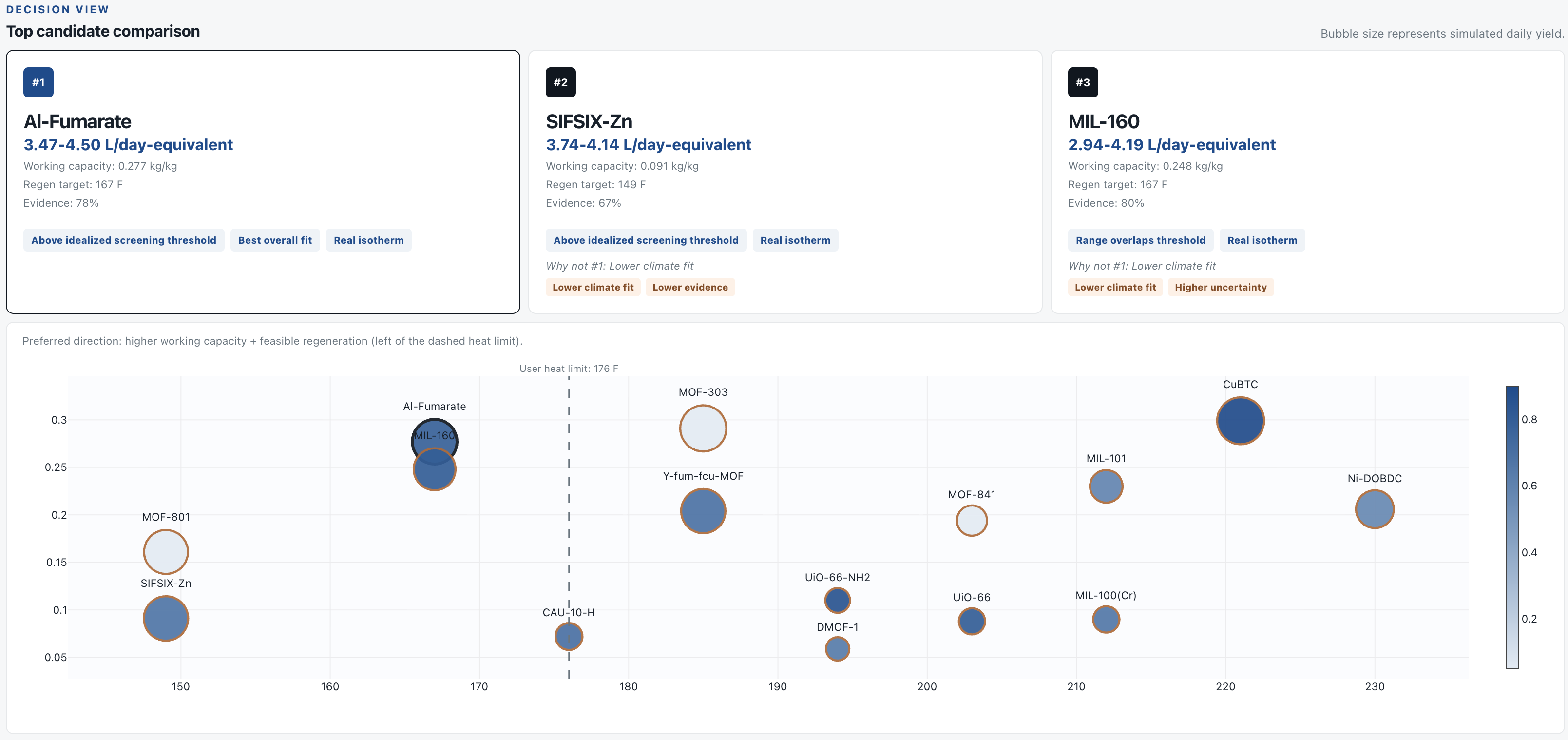
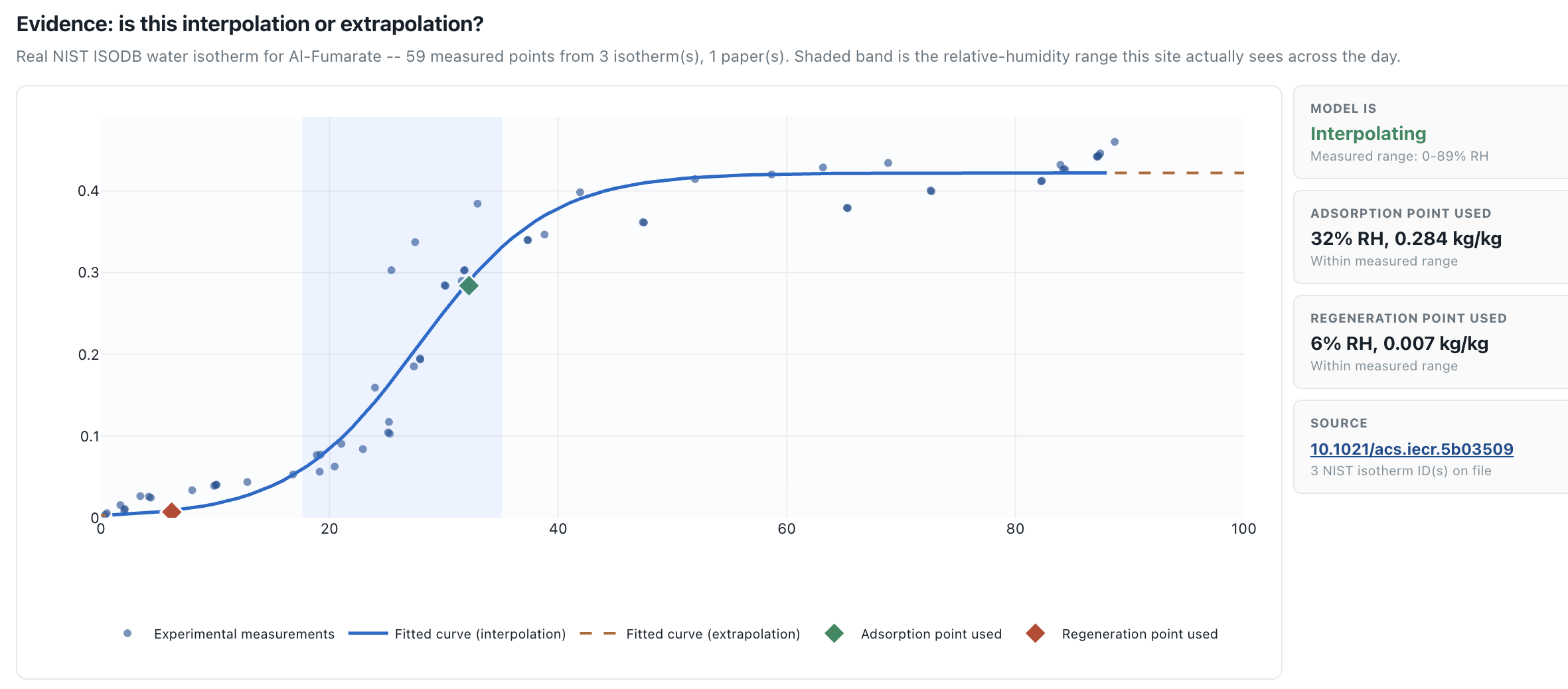
Real screens from the public application, cropped and otherwise unedited. All outputs are simulated research estimates, not certified device performance.
AirWater AI is a research-screening tool: it does not guarantee daily yield, potable water, lifecycle cost, or field safety.
What I Did
I designed and built AirWater AI as a functional proof of concept, from the data pipeline to the web application, and released the source code, data provenance, and model results.
- Built the offline pipeline from NIST isotherm data to a traceable dataset
- Fitted uptake curves and scored the evidence for each material
- Trained and validated the water-uptake model
- Wrote the site-specific ranking and scheduling logic
- Added a refusal gate with seven decision checks
- Built and deployed the web application